When Did Vinyls Start Getting Popular Again



Long earlier the days of Spotify, Apple Music, and YouTube, vinyl records were all the rage.
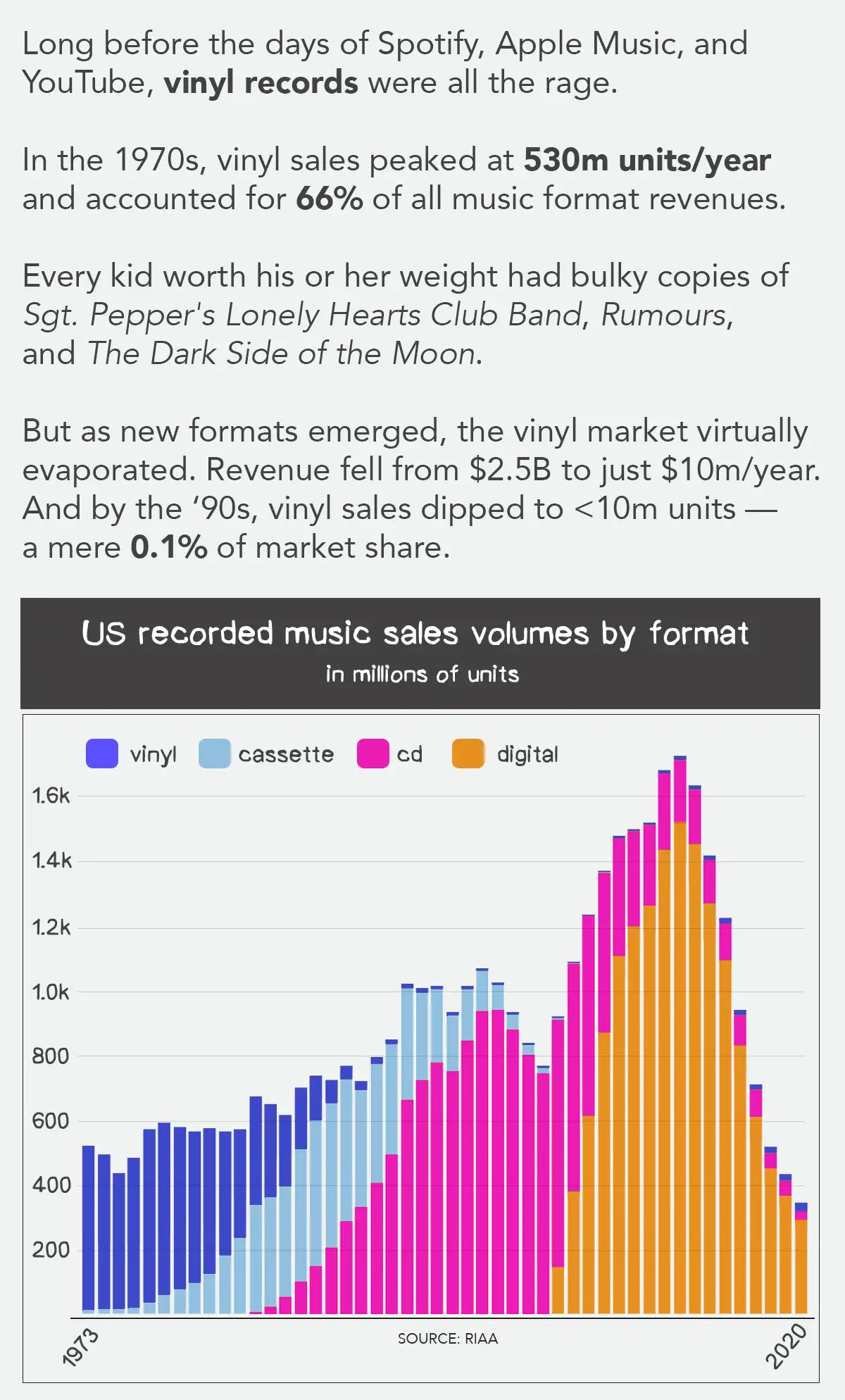
In the 1970s, vinyl sales peaked at 530m units/yr and accounted for 66% of all music format revenues.
Every kid worth his or her weight had bulky copies of Sgt. Pepper's Lonely Hearts Club Band, Rumours, and The Dark Side of the Moon.
Only equally new formats emerged, the vinyl market about evaporated. Revenue roughshod from $two.5B to only $10m/twelvemonth.
And by the '90s, vinyl sales dipped to <10m units — a mere 0.one% of market place share.
In recent years, though, something odd has happened: Vinyl has fabricated a small but mighty comeback.
Fueled largely by millennial hipsters under the age of 35, the quondam, outdated format has risen from the expressionless.
In an age of fleeting digital pleasures, vinyl has quenched a thirst for tangible assets.
For each of the past xv years, sales of new vinyl take gradually increased. In the starting time half of 2021 solitary, 17m albums were sold — an 86% bound from 2020.
In an extremely rare twist, an onetime technology came back to surpass a newer i.
Enjoying this article?
Get the Hustle'due south 5-minute weekday roundup that keeps you hip to happenings in tech, business, and internet… things.
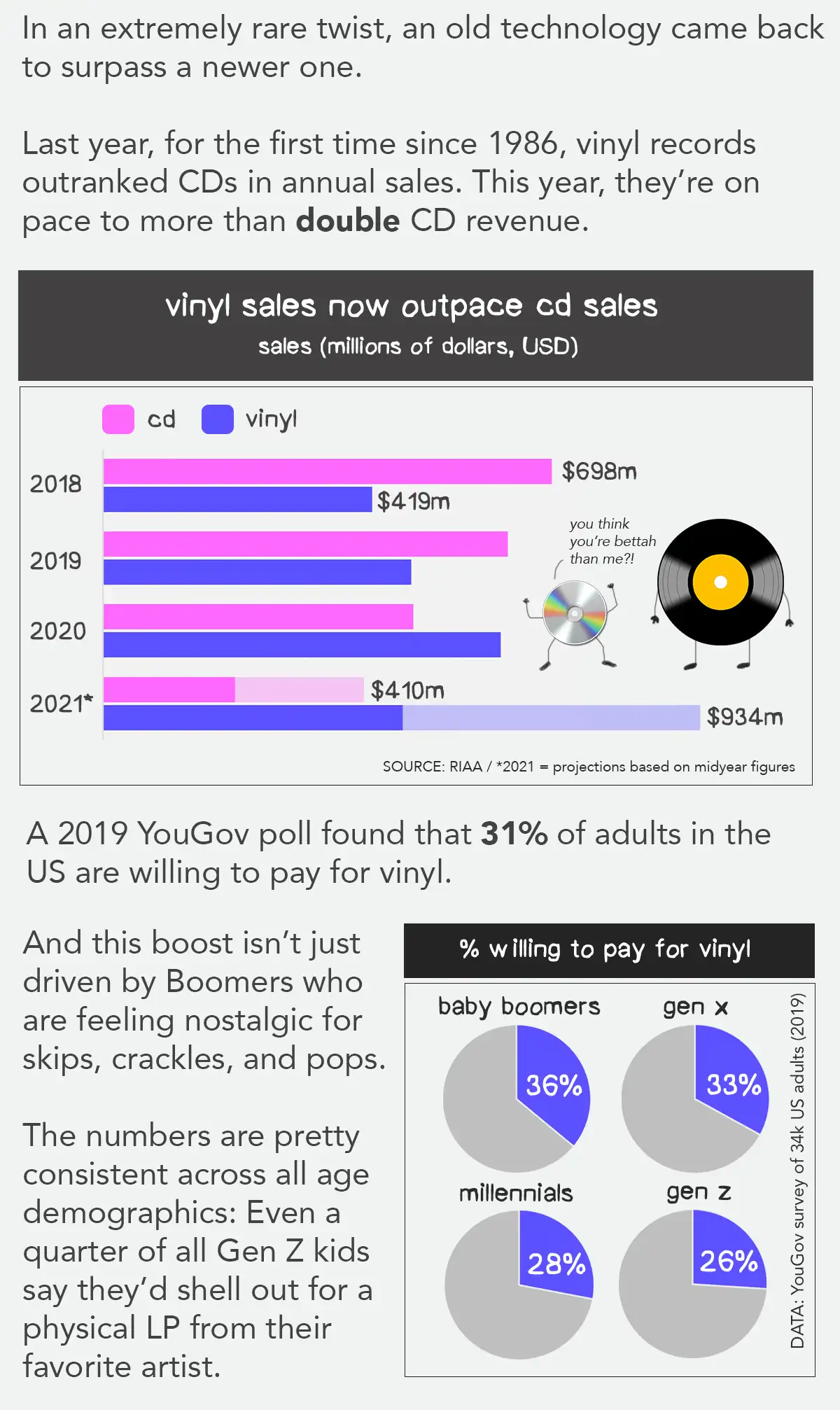
Concluding year, for the first time since 1986, vinyl records outranked CDs in almanac sales. This yr, they're on footstep to more than double CD revenue.
A 2019 YouGov poll found that 31% of adults in the US are willing to pay for vinyl.
And this boost isn't just driven by Boomers who are feeling nostalgic for skips, crackles, and pops.
The numbers are pretty consequent across all age demographics: Even a quarter of all Gen Z kids say they'd shell out for a physical LP from their favorite creative person.
A look at the summit-selling albums of 2020 presents an interesting glimpse into the diverseness of the market place.
These figures don't even include the millions of used records sold through online marketplaces similar Discogs (9m active listings) and eBay (three.5m), or at the 1.4k local record stores peppered throughout the US.
Per Forbes, used vinyl sales are likely 1.5x those of new records, or ~50m units based on 2021 projections.
For modern-day indie artists, it'south a welcome boom.
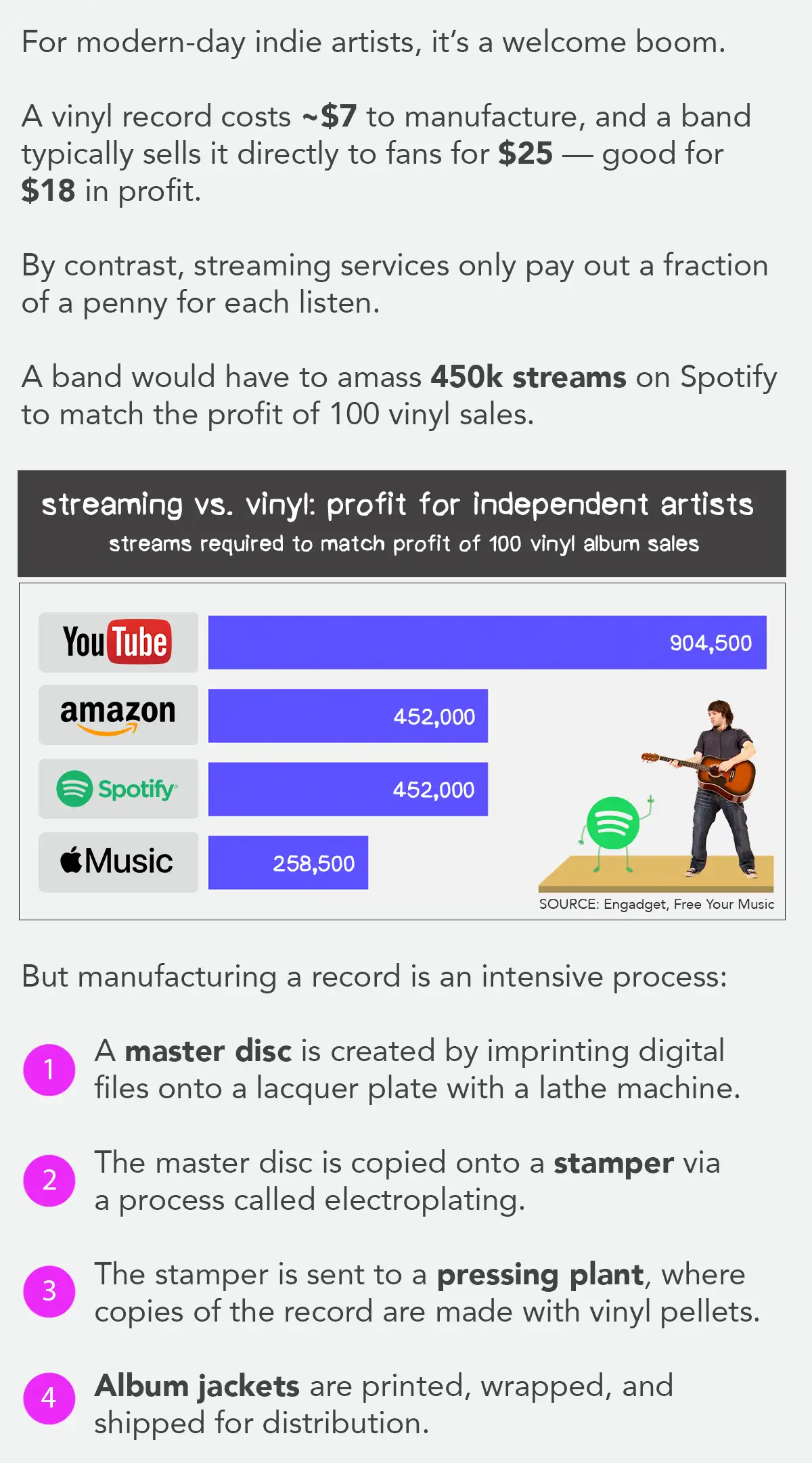
A vinyl record costs ~$vii to manufacture, and a ring typically sells it directly to fans for $25 — good for $18 in turn a profit.
By contrast, streaming services simply pay out a fraction of a penny for each listen.
A band would have to aggregate 450k streams on Spotify to match the turn a profit of 100 vinyl sales.
But manufacturing a tape is an intensive process:
- A master disc is created by imprinting digital files onto a lacquer plate with a lathe machine.
- The master disc is copied onto a stamper via a procedure called electroplating.
- The stamper is sent to a pressing institute, where copies of the record are made with vinyl pellets.
- Album jackets are printed, wrapped, and shipped for distribution.
And the vinyl manufacture faces a problem: Supply-side issues are making information technology difficult to come across demand.
For starters, polyvinyl chloride (PVC) — the main ingredient used to make records — has quadrupled in price since 2020 thanks to a pandemic-fueled tight supply, increased freight surcharges, and a big bump in demand from the structure industry.
The bigger issue, though, is the dearth of pressing plants, where records are fabricated.
When vinyl declined in the '80s, many plants shuttered. By some estimates, just ~40 exist worldwide today — and simply a few are capable of pressing big volumes.
Last year, matters got worse when a burn wiped out 1 of 2 plants in the world that made lacquer discs.
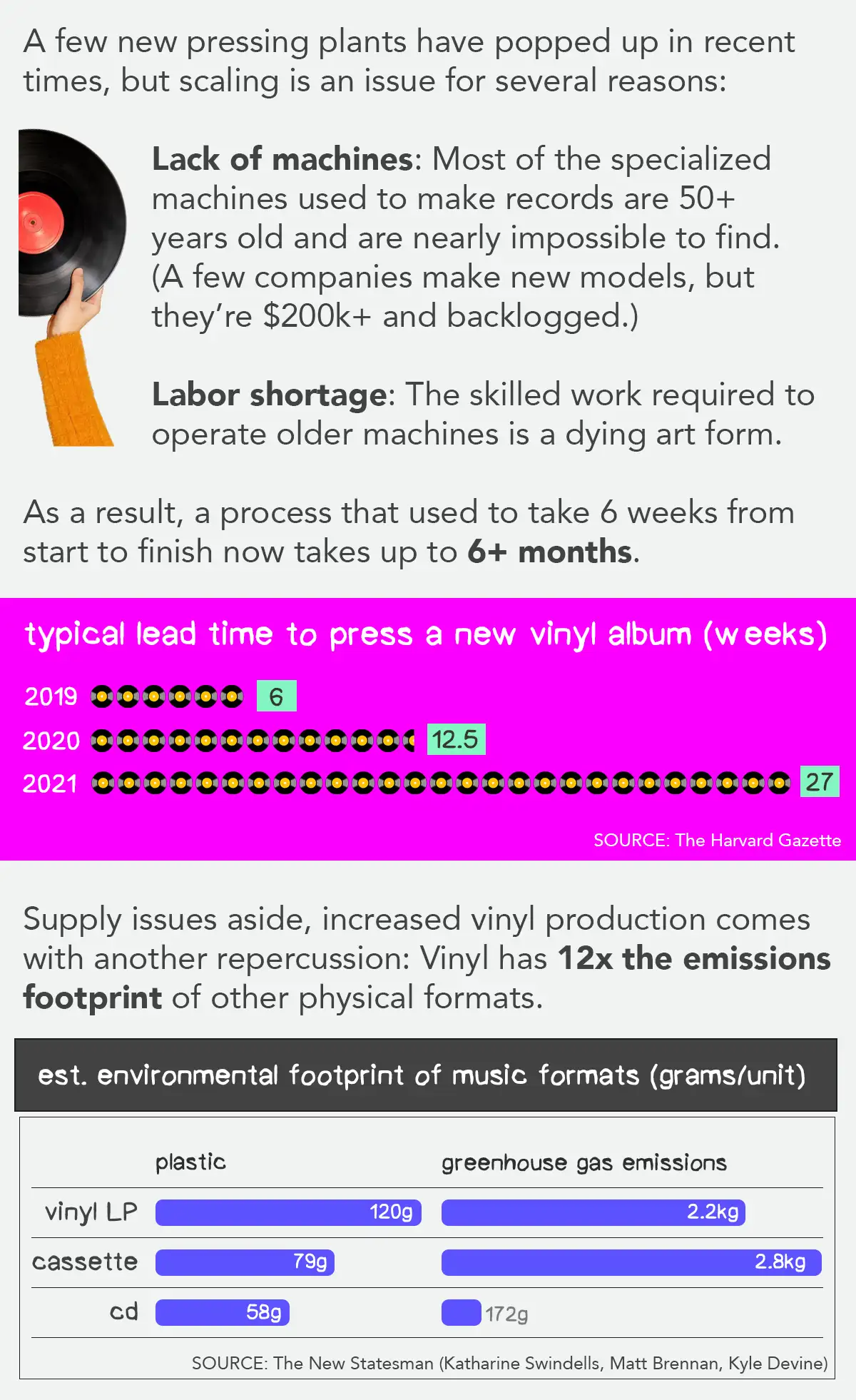
A few new pressing plants have popped up in recent times, but scaling is an issue for several reasons:
- Lack of machines: Most of the specialized machines used to brand records are 50+ years old and are nearly impossible to discover. (A few companies make new models, but they're $200k+ and backlogged.)
- Labor shortage: The skilled work required to operate older machines is a dying art form.
As a result, a process that used to take six weeks from start to finish now takes upwards to 6+ months.
Supply issues bated, increased vinyl product comes with another repercussion: Vinyl has 12x the emissions footprint of other concrete formats.
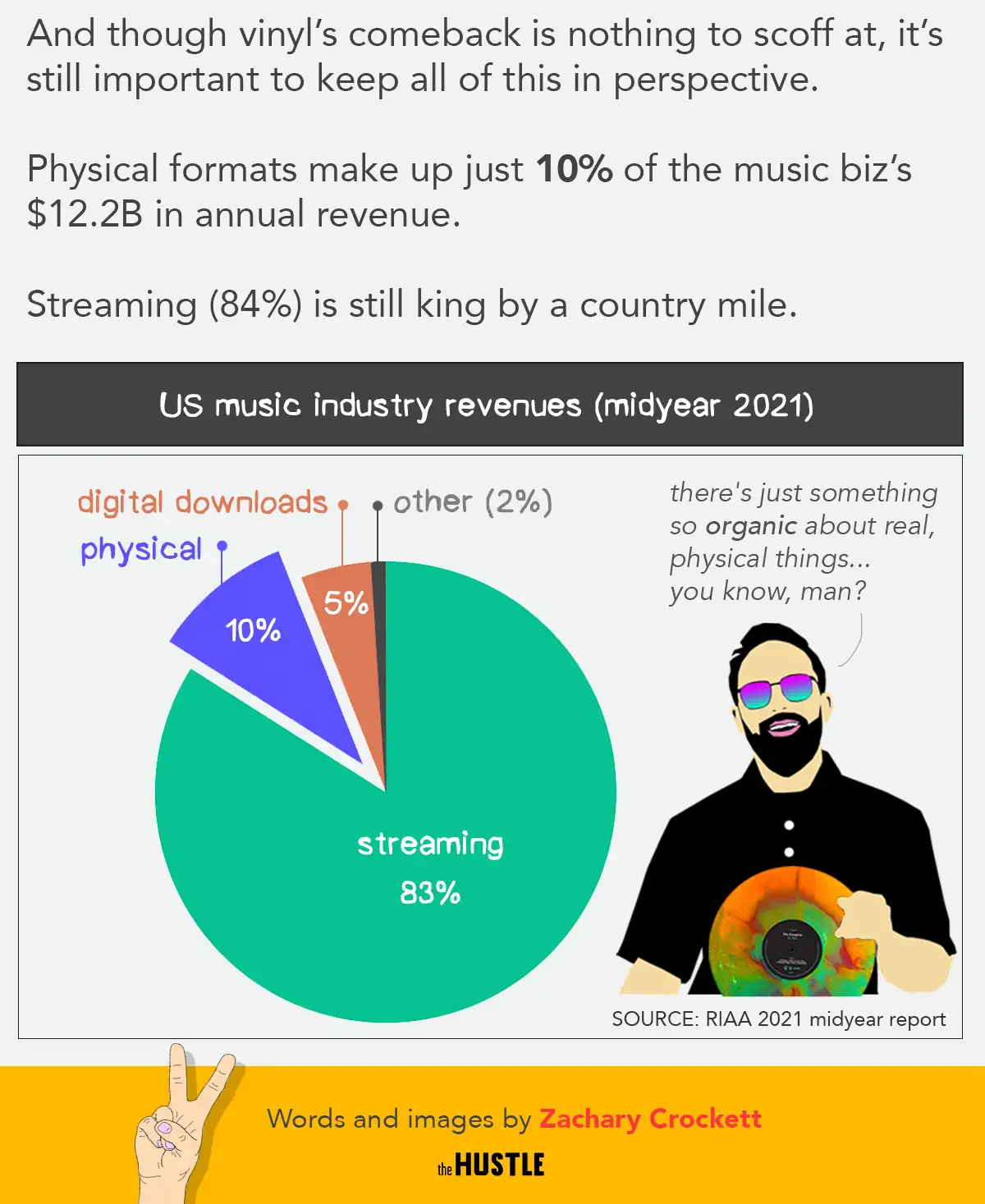
And though vinyl's comeback is nothing to belittle at, it's still important to keep all of this in perspective.
Physical formats make up just 10% of the music biz'southward $12.2B in annual acquirement.
Streaming (84%) is nonetheless king by a country mile.
Get the v-minute roundup y'all'll really read in your inbox
Business and tech news in v minutes or less
Source: https://thehustle.co/the-insane-resurgence-of-vinyl-records/
0 Response to "When Did Vinyls Start Getting Popular Again"
Post a Comment