Would States Be Better Off if Governors Were Elected by Their Legislatures Again
Land legislatures could face legal and perhaps even country constitutional crises after Ballot Solar day, if they're pressured to change how they traditionally allocate electoral votes.
Recent media reports indicate that Trump's entrada is considering asking some of the 29 land legislatures with Republican majorities, in charge of a total of 300 balloter votes, to depart from current practice in choosing their Electoral College delegates. The request would be for those bodies to select Trump electors and order them to cast their ballots for the president, regardless of the candidate the states' voters actually preferred. A similar possibility arose in 2000, when the Republican majority in the state's legislature claimed to possess "broad authorization to allocate Florida's electoral votes," and came close to doing and then.
As a student of American democratic politics, I believe that while there are some legal barriers that could limit the power of legislative bodies to condone popular vote totals in the allocation of their balloter votes, the nearly important constraints would be political.
A president picked this way past state legislatures would likely have his legitimacy questioned – and the legislatures would besides probable face the public's ire.
A base in the Constitution
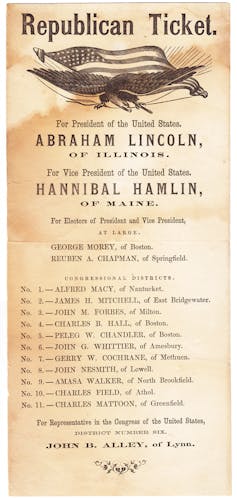
Article 2 of the U.S. Constitution leaves decisions about how electors will be chosen to state legislatures: "Each State shall appoint, in such Way as the Legislature thereof may direct, a Number of Electors, equal to the whole Number of Senators and Representatives to which the Country may be entitled in the Congress."
In the country's early years, some legislatures did non trouble themselves to involve their citizens in choosing the president. When George Washington was first elected in 1788, the legislatures of Connecticut, Delaware, Georgia, New Bailiwick of jersey and S Carolina appointed electors direct without a popular vote. The New York state legislature did not even choose electors because lawmakers couldn't resolve the divide betwixt its two chambers, which were controlled by different parties.
The start several presidential elections followed a mixed pattern, with some states using popular elections to directly the choice of electors, while others left that pick solely to their legislatures. As political parties jockeyed for advantage, states changed their systems oft.
No state legislature has ever appointed a slate of electors supporting a candidate who lost the state's popular vote. As the Supreme Court noted in the recent "faithless electors" example, by 1832, every state except South Carolina had passed legislation saying that the pop vote would determine the choice of its electors.
In 1876, newly admitted Colorado became the last country whose legislature chose electors on its ain. Today the laws of every state requite voters the final say about which party the electors should represent.
The Supreme Court'south view
State legislatures accept given up the power to choose electors, but the Supreme Courtroom has on several occasions recognized their right to have it dorsum.
The first conclusion was in 1892, when the court declared that "the legislature possesses plenary dominance to directly the fashion of appointment, and might itself practise the appointing ability past articulation election or concurrence of the two houses, or according to such style as information technology designated."
More than 100 years later, the courtroom revisited the question in Bush v. Gore. In a little noticed just highly consequential passage, the bulk wrote that a land legislature "may, if information technology then chooses, select the electors itself," and it retains authority to "take back the power to engage electors," even if it formerly let the popular vote make the decision.
In a July 2020 decision, the Supreme Court over again declared that Article Two gives land legislatures "the broadest power of determination" over who becomes an elector. However, the bulk opinion did suggest that power might exist subject to "some other constitutional constraint."
What are the limits?
The court has declared that states have the correct to take dorsum the choice of electors from the people – but has cautioned that they may not do so easily.
When states give the voters command over electoral picks, they confer on them a "fundamental" right, which is protected by other constitutional guarantees, including the due process and equal protection clauses.
Just information technology's non clear how strong that protection might actually exist. Country legislatures would almost certainly accept to pass a new law or resolution to brand any change. In each state, a majority of legislators would have to agree. And, depending on the form of the enactment, information technology might or might not be subject to a governor's approval – or a veto override.
Historically, courts have respected legislative decisions to alter how a land appoints electors so long as the changes happen before the election happens, not after the ballots are cast.
[Insight, in your inbox each twenty-four hour period. Y'all tin go it with The Conversation'south email newsletter.]
A matter of timing
Mail-election changes of the kind the Trump campaign is reportedly contemplating would cause confusion around ii federal laws that directly contradict each other.
One law requires electors to be appointed on Election Day itself. But all states abide past another constabulary, the Electoral Count Act, passed in 1887, which gives states upward to 41 days after Election 24-hour interval to designate their slate of electors. The conflict betwixt these laws provides fertile ground for litigation.
In the finish, however, the about effective forces blocking land legislatures from disregarding the pop vote may be political, rather than legal. It is, later on all, upward to the people to hold their officials accountable for their deportment.
Nonetheless in the state's current toxic political environment, it'southward not clear whether even an obvious attempt to ignore the popular vote might nevertheless notice support among some of the public, and some of their elected representatives too.
Source: https://theconversation.com/could-a-few-state-legislatures-choose-the-next-president-146950
0 Response to "Would States Be Better Off if Governors Were Elected by Their Legislatures Again"
Post a Comment